Societal Violence and the Classroom: How to Discuss Events With Students
Social violence is an occurrence that affects everyone, not just adults. Children and adolescents do not yet have the capacity to process these events by themselves and will bring questions and concerns into the classrooms in different ways. In our blog, we plan to briefly review different occurrences of social violence that has an impact in our world. We also be considering different age-appropriate tactics to have discussions with students in the classroom regarding social violence.
Teaching about current events is a way for our middle school students to learn what is going on in the outside world. However, in this age of social media and electronic news, it is sometimes difficult for these young adolescents to disseminate what is real news and what is "fake news". Due to this, some educators are shying away from teaching current events to their students. This blog post from Edutopia challenges that idea and gives some suggestions on how to tackle this issue of negative news in an age-appropriate way.
Today I was at work (I work as a substitute teacher in a local middle school) and a student came up to me with a question. She had just read about a shooting not far from her home and she saw a video about the terrorist attack in Egypt.
Student: Ms. A...Will things ever get better? It seems like every day someone is being killed over something stupid or someone is attacking a group of people. I mean, come on. Why is it like this?
After the student asked the questions, I had to take a moment to think about the complexity of what she was asking. I don't know exactly when violence in the world will end, but I can only hope it will eventually. This is what I needed to tell the student. It is important that I am honest but positive with my answer.
Ms. A: (sigh) Honestly, I don't know when it will end. All through history there have been moments of violence in the world. All we can do is hope that one day it will end. Until that time we need to do our best to be a positive example of what the world should be like. Rather than be hateful and violence, we should be kind to others. If we see hatred, we should stand against it.
This conversation was awkward, I won't lie, but my student was looking to me for reassurance. As teachers we need to be that positive figure in our students lives. They should know that they can come to us with their questions and concerns and that we will do our best to answer them.
While students where on vacation and celebrating Thanksgiving with their families, other countries experienced forms of violence and terrorism.
After returning from Thanksgiving break, some students may have heard the news about the terrorist attack in Egypt or the man escaping North Korea. This is an example of when CNN 10 can be used to help introduce these topics and form discussion with students. After watching the video, take time to discuss the content with students and answer any questions they may have.
Bellow is the link to the CNN 10 video from Monday, November 27th.
Jackson Katz is an anti-violence educator and lecturer who has produced several videos on the connection between what society has told our children, specifically boys, what it takes to be masculine or "manly" and the adverse effects it can have on our children progressing into adulthood. This video clip from Tough Guise: Violence, Media & the Crisis in Masculinity delivers a powerful message about how the way that society and the media has shown our youth what it takes to be a "man" and how they need to put on this "guise" to be viewed as masculine.
Some questions for discussion with your students after viewing the video clip*
1. What are some benefits to boys and men of putting on the “tough guise”? When is it an effective and adaptive
response, and when is it self-destructive and dangerous to others?
2. Many cultural commentators have noted that media representations of men of color (e.g. news accounts,
roles in film and television, and sports) have disproportionately shown them to be aggressive and violent. What effect
do these portrayals have on the gender identity formation of boys and men of color? How do these portrayals
influence the way the white majority sees men of color?
Activity to do with your students after viewing the video clip*
1. The Box Exercise: Draw a box on a chalkboard. Ask students to name characteristics of a “real man”. Write
them inside the box. When the box is full, ask for themes (e.g. strength, toughness are equated with masculinity).
Then ask them to name characteristics of men who don’t measure up, and write these outside the box. When
you’ve gotten a sufficient number of words (e.g. wimp, wuss, fag), ask for themes. Then talk about how boys/men
are boxed in by these definitions, and punished if they don’t fit in.
*the questions and activity were taken from the companion website to Tough Guise, which could also be helpful for further study in the classroom:
One way to get students talking about their feelings after an occurrence of societal violence is through Advisory. One way to do this could be through a Sharing Session
Ask students to write down their feelings and reactions to what has happened. It can be a few sentences, but they should work by themselves to encourage them to get the feelings that they may have about the event out of their minds.
Have the students sit in a circle, and ask for volunteers to share what they wrote
Since Advisory is considered a safe place to share, students should be aware of the rules set forth for discussion, but gentle reminders about being respectful and listing to what others are saying will be helpful since emotions could be running very high after a tragic event.
Talk candidly about what the student shared and open the floor for discussion with the class.
For some tips on how to handle rough topics during Advisory, click here
Talking to children and students about mass shootings and issues of violence in society is a difficult topic. This news clip from ABC gave some good quick hits on how to talk to your children when social violence happens.
Some students may not be as vocal as others. These students may still have questions. For these students, it is important that these students have a way to ask their questions. This advisory aims to help those students by having them write a letter to their teacher with questions or concerns they may have.
Briefly discuss the societal violence that has taken place.
On a piece of paper, have each student write down any questions or concerns they may have regarding the events. If students have no questions, they may also write any thoughts or feelings they may have. Students should leave room for the teacher to reply.
Students will hand their letters into their teacher. The teacher will then read each letter and write a reply to the student. The answer should be honest but age appropriate.
After answering the questions, the teacher will pass back the letters. If students have any further concerns, they may approach their teacher.
Example
Dear Teacher,
The Las Vegas shooting was very scary to hear about. I'm going to a concert in the summer. Will I be safe?
Dear Student,
The shooting was a very scary for many people. After the shooting, many places are making sure that the areas inside concert venues and around them are safe. You will also be attending the concert with people who will keep you safe. There will be security checks at the concert to ensure you and other concert goers are safe.
Sometimes it can be hard to start a conversation about societal violence. Some students in your class may know about the events, some may have seen pictures and graphic videos from the event, other students may have no knowledge at all.
One way to introduce topics of societal violence is through the use of a classroom friendly news report. CNN 10 is a series of ten minute video that are published by CNN. The videos contain news reports that can range from topics of societal violence to "feel good" stories that were featured in the news.
Why CNN 10?
CNN 10 approaches the topics of societal violence in a calm, informative, and appropriate way. The videos do not contain graphic images that may scare students, but they report the events with honest and straight forward details. The videos will also have many other topics to talk about, so the students don't need to focus on the one event for a long period of time.
Here are a few example videos of CNN 10 addressing societal violence
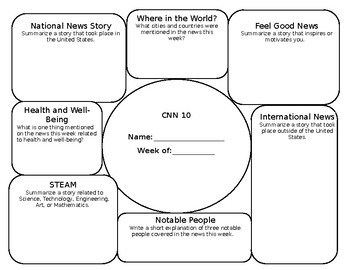
After watching the video, it is time to discuss the content with students. One way to help students collect there thought is through a graphic organizer. There are many graphic organizers available online that are related to CNN 10. Allow students to rewatch the video and take notes on a topic of their choice. This will allow students to talk about the events of societal violence if they wish, but allow students to talk about something else. Once the sheets are fill out, let students share their topic with the class. If students ask questions, it is important to answer then honestly but not be graphic with details. Reassure them that they are safe.
One area of concern that comes up when there is an incident of societal violence is media coverage. Some of the images are very graphic and can have lasting effects on our students. This is a brief slideshow depicting what visuals that children and adolescents are exposed to on a daily basis.
Trying to shield children from violent images may not always be possible. A helpful article on how to talk about these images with your children and students is here:
What do you do when a student asks a question regarding mass violence in the world?
What would you do if a student came into school after the Las Vegas shooting and asked if they were safe? What would you say if the student asked why a person would do that? Societal violence can be a sensitive topic within schools and it can be hard to discuss with students. As educators it is important to know how to approach these situations and what to say to our students to ensure their safety and concerns without over stepping boundaries.
In the article Mass shooting in Las Vegas: How to Talk to Students by Cindy Long, she notes the importance of discussing societalviolence and how to talk about it based on grade level. In middle school students will be asking questions and wanting answers on their safety and why the events are happening. Long states that we should take time to listen to the students, be patient with them, and answer their questions in an age appropriate way.
"Upper elementary and early middle school children will be more vocal in asking questions about whether they truly are safe and what is being done at their school. They may need assistance separating reality from fantasy. Discuss efforts of school and community leaders to provide safe schools."
Examples
Student: I don't get it. How could someone shoot a baby like that? Teacher: Understand it is very disturbing to think that someone would shoot an infant. The person who did this was not even thinking about who they were shooting. Their idea was just to try to inflict the most harm as quickly as they could. I don't think he even saw who was harmed.
Student: Why would someone do something like that?
Teacher: It is very hard to understand why someone would do such a thing. Some people don't have the emotional capacity to understand the difference between right and wrong. In their mind they weren't doing anything wrong, they were doing what their ideology thought was right.
Student: Could that happen here?
Teacher: It is not likely for something like that to happen here. You are safe within school and the staff is always finding new ways to keep you safe.
Student: Are we safe here?
Teacher: Yes, you are safe. The school has many procedures in place to ensure your safety. We also have practice drills that we do at the school in case something ever happens. These drills will help keep you safe.




Teacher: Understand it is very disturbing to think that someone would shoot an infant. The person who did this was not even thinking about who they were shooting. Their idea was just to try to inflict the most harm as quickly as they could. I don't think he even saw who was harmed.